|
|History
of Bosham
"Better have been a fisherman at Bosham, my good Herbert*: Thy
birthplace; the sea creek; the pretty rill that falls into it; the
green field; the gray church; the simple lobster-basket and the
mesh; the more or less of daily labour done "
* Herbert of Bosham - Secretary to Thomas à Becket.
Thus
wrote Alfred, Lord Tennyson, in his 'Becket', after visiting Bosham
in 1875. The description still holds true today. Decades ago, there
were many such villages along the Sussex coast. Now, Bosham is
unique. Twice a day, the tide laps under the windows of the little
cottages along the shore. In former times, these were occupied by
the local fishermen. A large oyster industry, second only to
Whitstable, was enjoyed at Bosham. Oysters were dredged from the
Solent
and dropped into the Harbour to grow for two or
three years. They were then put into beds, which ran the length of
the waterfront, before being taken to market.
Christianity
Bosham is the oldest Christian site in
Sussex.
There was a Christian congregation here, 200 years before Augustine
landed in Kent. It had a resident monk, Dicul, who came from
Ireland, living in a small, rough cell below the church. (This can
be visited.)
The Church, dedicated to the Holy Trinity, is thought to have been
built on
the site of a Roman Basilica - the bases of the Chancel arch pillars
are all that are left of that earlier building. (A villa with a
central court built in the reign of Antoninus has been excavated in
the grounds of Broadbridge Farm in
Delling Lane,
along with a marble head, a Roman bath and a small amphitheatre.)
The present building is largely Saxon, the first parts of it being
built in the early 11th Century, during the reign of Canute - (He
lived at Bosham for a while, and it is strongly believed that his
eight year old daughter died here, and is buried in the Church. A
skeleton of such a child has been discovered here, and the place is
marked with a stone slab, bearing the Danish emblem of a raven.)
The Chancel was built in three stages - the first, in the somewhat
untidy stonework of the Saxons, (look at the Tower); followed by the
neat herring-bone of the
Normans;
with the third stage in the Early English style. (The East window of
the Chancel is one of the finest examples of this style in the
country.
King
Canute
The famous 'legend' of Canute trying to repel the waves is
associated with many places along this coast, but Bosham seems to
have the strongest claim!
The remains of Mud Wall can be seen at low tide. It was built at the
end of the 18th Century, and the land to the North was used as farm
land. The wall was breached in the 1840s by a tremendous storm. This
dyke recalls the story of Canute, sitting on his chair, surrounded
by his courtiers, ordering back the tide - unsuccessfully, so the
chronicles stat! It is probable that Canute built a dyke, the Saxon
word for which is 'char', but for some reason, the dyke did not hold
back the tide. Mud Wall would be the most likely place for Canute to
have built his 'char'. Modern day Canutes who leave their cars on
the foreshore,
may
experience the same frustration as their historic counterpart!!
King Harold / Bayeux Tapestry
Bosham Church is the only Church depicted on the Bayeux Tapestry -
it shows the Chancel arch. After the death of his father, Earl
Godwin, the Manor and Church of Bosham were inherited by Harold,
Earl of Wessex. It was from Bosham that Harold set sail in 1064, to
argue with William of Normandy, who would inherit the throne of
England after the death of Edward the Confessor, whose wife was a
sister of Harold. On his return to England, to the great anger of
William, Harold was crowned King of England. When Harold was killed
at the Battle of Hastings, William became King, and took over the
Manor and Church of Bosham as a Royal domain.
In the Domesday Book of 1084, Bosham Church was one of the
wealthiest Churches in England, with property amounting to thirteen
thousand acres of land in different parts of the country.
The
Bosham Bell
In
the days of King Canute, a fleet of Danes sailed up Bosham Channel
to plunder the village and Church. They captured the tenor bell. As
they made off back down the channel, the monks ran to the tower to
ring a peal in thanks for having been spared. As the remaining bells
rang out, the tenor bell moved in sympathy, and fell through the
bottom of the boat. The monks prayed in vain to St. Nicholas, for
his help in recovering the bell. They purchased a new bell-rope and
a team of pure white heifers. All was
progressing well, and the bell was about to be landed, when, when
someone noticed that one of the heifers had a single black hair in
its tail. The rope snapped and the bell plunged back into the mud,
where it remains to this day. On a still day, its muffled tones can
be heard below the water. (The badge of Bosham Sailing Club is a red
bell on a white background.)
Men
of Bosham
During the Plague year of 1664, the people of Bosham took food to
citizens of Chichester, who were confined within the City Walls.
Because of this Christian charity, they were granted the right to
sell fish in any market in England without paying tolls. They have
the rights to free mooring, wild-fowling, and fishing within the
waters of Bosham Harbour.
Other
Facts About Bosham
The
Anchor Bleu public house -
A
building of special architectural and
historic interest (Listed). Became an inn in 1740, but dates back
further.
Bosham Sailing Club -
A
working mill until the 1930s.
The Millstream Hotel -
Once called 'The Grange'. Purchased by Hugh Selwyn
Lloyd
in 1913, after selling the Manor House (purchased 1899).
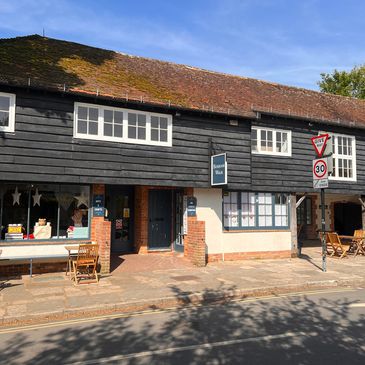
Bosham Walk -
was
once a garage owned by Glyn Martin.
Dylan
Thomas
lived
in Bosham for 3 months during World War Two.
Ernest Hemingway
knew and loved Chichester Harbour - he was a war
correspondent here during World War Two.
|